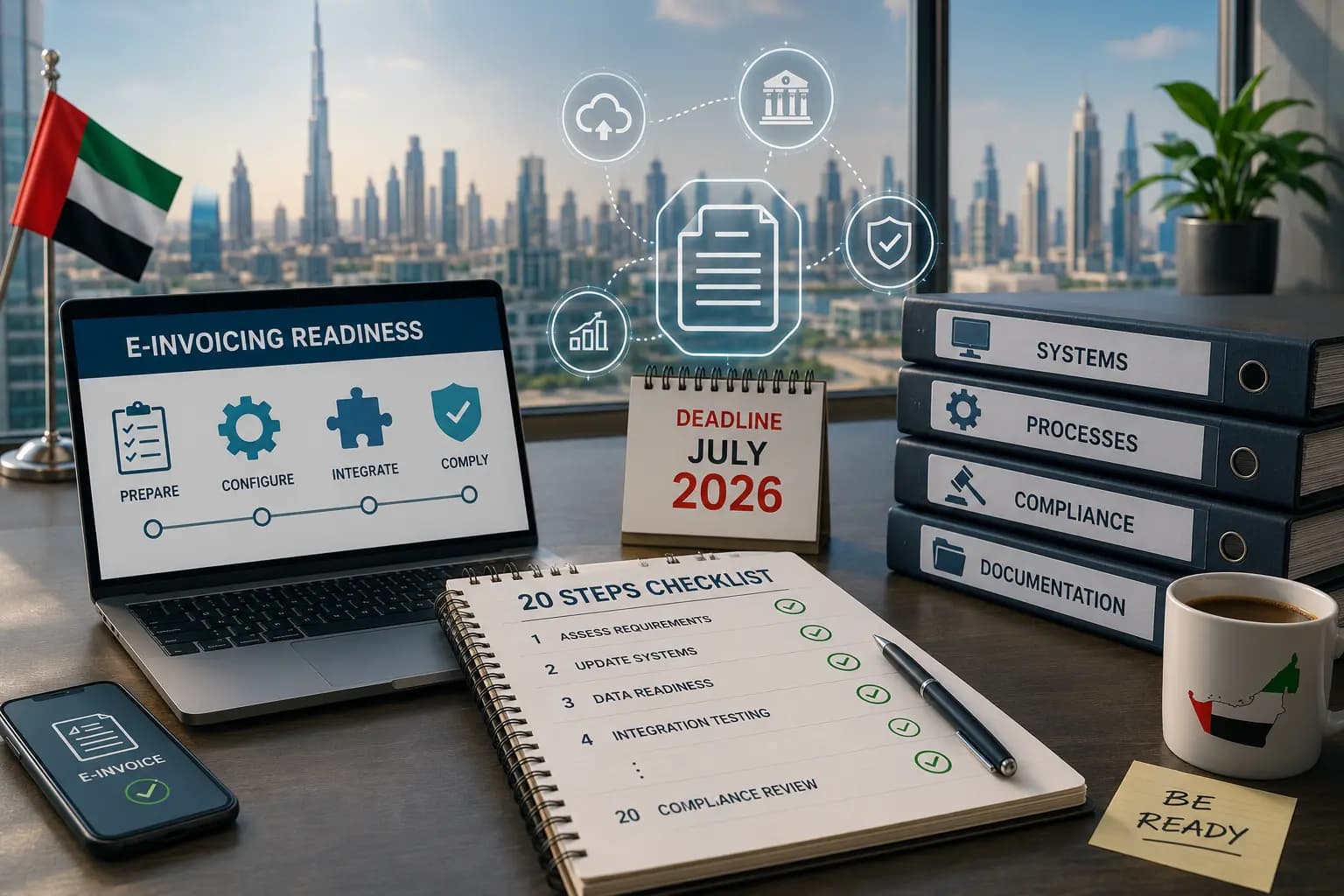
UAE E-Invoicing Readiness: 20 Steps to Complete Before July 2026
E-Invoicing
June 23, 2026
UAE e-invoicing has moved from policy discussions into practical preparation. With the pilot programme set to begin on July 1, businesses are reviewing the less glamorous parts of invoicing. It includes customer names that do not match records, VAT codes used inconsistently, old credit-note habits, and finance teams still relying on someone’s memory to fix things at month-end.
That is the uncomfortable truth behind e-invoicing. Most businesses do not need another invoice template. They need cleaner data and a process that does not fall apart when the person who “knows how it works” is on leave.
July 1 is not the mandatory deadline for every UAE business. It marks the start of the pilot programme for selected taxpayers. Still, companies with annual revenue of AED 50 million or more have a closer action point: appointing an Accredited Service Provider by October 30, 2026.
For everyone, July is the point where e-invoicing stops being something to watch from a distance.
What UAE E-Invoicing Actually Changes
E-invoicing is not simply sending a PDF by email. A PDF invoice may look formal. It may have the company logo, VAT amount, payment terms, and a signature line. But structured e-invoicing is different.
The invoice data must move through the required electronic system in a format that can be processed accurately by software, service providers, and the authorities.
This means businesses need to think beyond invoice design.
They need to review:
Where invoices are created
Which system owns the customer data
Who approves invoice changes
How credit notes are issued
If VAT treatments are correctly mapped
What happens when an invoice is rejected or contains incomplete details
The software matters, but the business process matters just as much. A good system cannot fix a customer record that says “ABC Trading” in sales, “A.B.C. Trading LLC” in accounts, and something else in an Excel sheet kept by a branch office.
The UAE E-Invoicing Timeline Businesses Need to Know
The UAE is introducing e-invoicing in phases. That gives businesses time, but it also creates a risk. Some companies may assume they can ignore the preparation work until their exact go-live date is near.
That usually creates more work, not less.
Here is the current timeline:
July 1, 2026: Pilot programme begins with selected taxpayers.
Businesses with annual revenue of AED 50 million or more: Must appoint an Accredited Service Provider by October 30, 2026, and implement e-invoicing from January 1, 2027.
Businesses with annual revenue below AED 50 million: Must appoint an Accredited Service Provider by March 31, 2027, and implement e-invoicing from July 1, 2027.
In-scope government entities: Must appoint an Accredited Service Provider by March 31, 2027, and implement the system from October 1, 2027.
The deadline may look far away for smaller companies. But invoice data cleanup, software integration, user testing, and staff training do not happen properly in one rushed week.
UAE E-Invoicing Readiness Checklist: 20 Steps to Complete
1. Understand the governing decisions
Do not rely only on social media posts or a colleague’s half-remembered explanation from a finance meeting.
Read the governing decisions, guidelines, scope rules, implementation dates, and penalties. The UAE framework is detailed because it affects invoice data, VAT processes, reporting, technical integrations, and business records. A quick summary can help, but it cannot replace knowing what applies to your own business.
2. Confirm that your business is also in scope
Many businesses assume e-invoicing only applies to VAT-registered companies. That is not the right way to look at it.
The system applies to business transactions within scope, subject to stated exclusions. Businesses need to review their activity, buyer types, transaction types, and if they issue B2B or B2G invoices.
3. Identify your go-live date
This sounds basic, but it is where many businesses lose time.
Check your annual revenue against the rollout phase and write down two dates: the date you need to appoint an Accredited Service Provider and the date you need to begin mandatory e-invoicing. Do not confuse the provider appointment deadline with the final implementation deadline. They are not the same thing.
4. Review all of the penalties
Penalties are rarely the first thing business owners want to read. Still, ignoring them does not make them less relevant.
Review the violations and administrative penalties linked to the e-invoicing framework. This is not about creating panic in the accounts department. It is about understanding what can happen when invoices are not issued, transmitted, stored, or managed according to the required process.
5. Gap analysis
A gap analysis is simply an honest comparison between what your business does today and what the new system expects.
Look at invoice types, tax treatments, credit notes, buyer information, supplier information, approval processes, ERP fields, and data quality. The gaps are often not dramatic. A missing customer address, an outdated TRN, or a vague product description can create trouble when data is expected to move cleanly between systems.
6. Register with the FTA to confirm your TIN
Your Tax Identification Number, or TIN, matters because it becomes part of your identity in the e-invoicing system.
For businesses already registered with the Federal Tax Authority, the TIN is generally the first 10 digits of the TRN. Businesses that fall within scope but are not registered for a tax type may need to register with the FTA to obtain their TIN. This should not be left until onboarding begins.
7. You need to update your company details in EmaraTax
This is one of those steps people delay because the details look harmless.
Check your trade licence information, legal name, address, email contacts, authorised persons, and other company details in EmaraTax. An old office address or inactive contact email may not seem serious until an onboarding request, verification message, or compliance update lands in the wrong place.
8. Confirm your TIN if you are part of a Tax Group
Tax groups need extra care. A business that belongs to a VAT group should not automatically use the tax group representative’s TIN for its own e-invoicing identity.
Each entity needs to confirm the correct TIN linked to its own registration details. This is the kind of detail that gets missed when several entities share the same finance team and accounting system.
9. Choose an Accredited Service Provider
An Accredited Service Provider, or ASP, will be the bridge between your invoicing system, the buyer’s system, and the UAE e-invoicing network.
Do not choose one only because the sales call was smooth or the price looked low. Review if the provider can support your invoice volumes, accounting software, business model, data hosting needs, technical support expectations, and future growth. The cheapest option is not always cheap once integration problems start.
10. Finalise your contract with your Accredited Service Provider
Choosing an ASP is only the beginning. The contract should clearly cover the commercial arrangement, service scope, technical responsibilities, support levels, implementation timelines, security requirements, and what happens when something fails. Nobody enjoys reading them during an invoice transmission issue, either.
11. Complete onboarding
The onboarding process must be initiated through EmaraTax. Businesses should follow the required process to select their ASP and continue onboarding on the provider’s platform.
12. Peppol Participant Identifier
Once onboarding is completed, your business receives a Peppol Participant Identifier.
This acts like a formal digital address for invoice exchange in the network. In the UAE framework, it is linked to the business identity used for e-invoicing. It is a small technical detail on paper, but it is what helps invoices find the right place without relying on someone manually forwarding an attachment by email.
13. Ensure your ERP system is ready
Your ERP or accounting system must be able to generate the required invoice data in structured XML format.
This is where the difference between a normal digital invoice and an e-invoice becomes clear. A PDF sent by email may still be useful for a human to read, but it is not the same as a structured invoice that systems can validate and exchange automatically.
14. Data transmission method
Your business and ASP need to agree on how invoice data will move from your ERP or accounting system to the provider.
It should also be clear how your business receives confirmation that an invoice was successfully transmitted, rejected, delayed, or reported. A finance team should not have to guess if an invoice reached the buyer or disappeared into a failed connection.
15. Entire system integrations
The ERP or accounting system needs to connect properly with the ASP platform.
That may involve API integration, middleware, data mapping, workflow updates, and changes to approval processes. Some businesses will find that their existing invoice approval chain was built for paper prints, PDFs, and email attachments. That is not necessarily a failure. It just means the process needs updating before the new system goes live.
16. Data storage and security
Electronic invoices are not documents that businesses can issue and forget. You must manage everything, including invoice records, structured data, audit logs, and security arrangements properly.
Taxable persons need to retain the records for five years. At the same time, the real estate-related records require longer retention.
17. Test the process
Testing should cover more than generating one successful invoice. Test invoice creation, data transmission, ASP validation, buyer receipt, reporting confirmation, rejected invoices, credit notes, and error messages.
18. Error resolution governance
Every system has errors. The real issue is what happens next. You need to set clear roles for your teams, including finance, IT, compliance, and the ASP. Without this, problems sit in shared inboxes while everyone assumes somebody else is handling them.
19. Go live with e-invoicing
Going live is not the end of the project. It is the point where the project becomes part of daily work.
Businesses should begin issuing and receiving e-invoices according to their rollout date, while closely monitoring system performance, invoice failures, reporting confirmations, and user issues. The first few weeks will probably be less smooth than vendors promise. That is normal. What matters is if the business has a working response process or not.
20. Post-go-live changes
Businesses change constantly. VAT registrations change. Companies join or leave tax groups. Branches open. Legal entities close. Trade licences are amended. Contact persons move on.
Your ASP needs to be updated when these changes happen. E-invoicing is not a one-time compliance setup. It becomes part of the company’s operating record, which means changes in the business need to be reflected in the system.
Why Waiting Until the Last Month Is a Bad Habit
Businesses often delay compliance projects because daily work feels more urgent. Orders need to go out. Payroll needs to run. Customers need answers. E-invoicing preparation can sit quietly in the background until the deadline becomes real.
But this is not only a tax task.
It touches sales, finance, IT, customer onboarding, reporting, and internal approval habits. The earlier a company finds weak data or disconnected systems, the easier it is to fix without interrupting normal business.
How Penieltech Can Help UAE Businesses Prepare
We supports UAE businesses with e-invoicing readiness reviews, accounting and ERP configuration, software integration, testing, and user training. Doesn’t matter if a company uses TallyPrime, Odoo, ERPNext, QuickBooks, or another business system, the practical focus should remain the same: clean data, reliable workflow, and a setup that suits the way the business actually operates. Penieltech provides exactly that to businesses.
The right preparation is not about making the process look advanced. It is about avoiding confusion when invoices begin moving through a structured system.
Conclusion
UAE e-invoicing is often discussed as though businesses only need to switch from PDFs to XML files. That explanation is too shallow.
The real shift is that invoice data will need to be clean, structured, traceable, and ready to move between businesses without someone manually correcting it halfway through. For many companies, the biggest task will not be selecting a provider. It will be facing the small process weaknesses they have learned to live with for years.
July 2026 is the point where that work becomes difficult to postpone.