
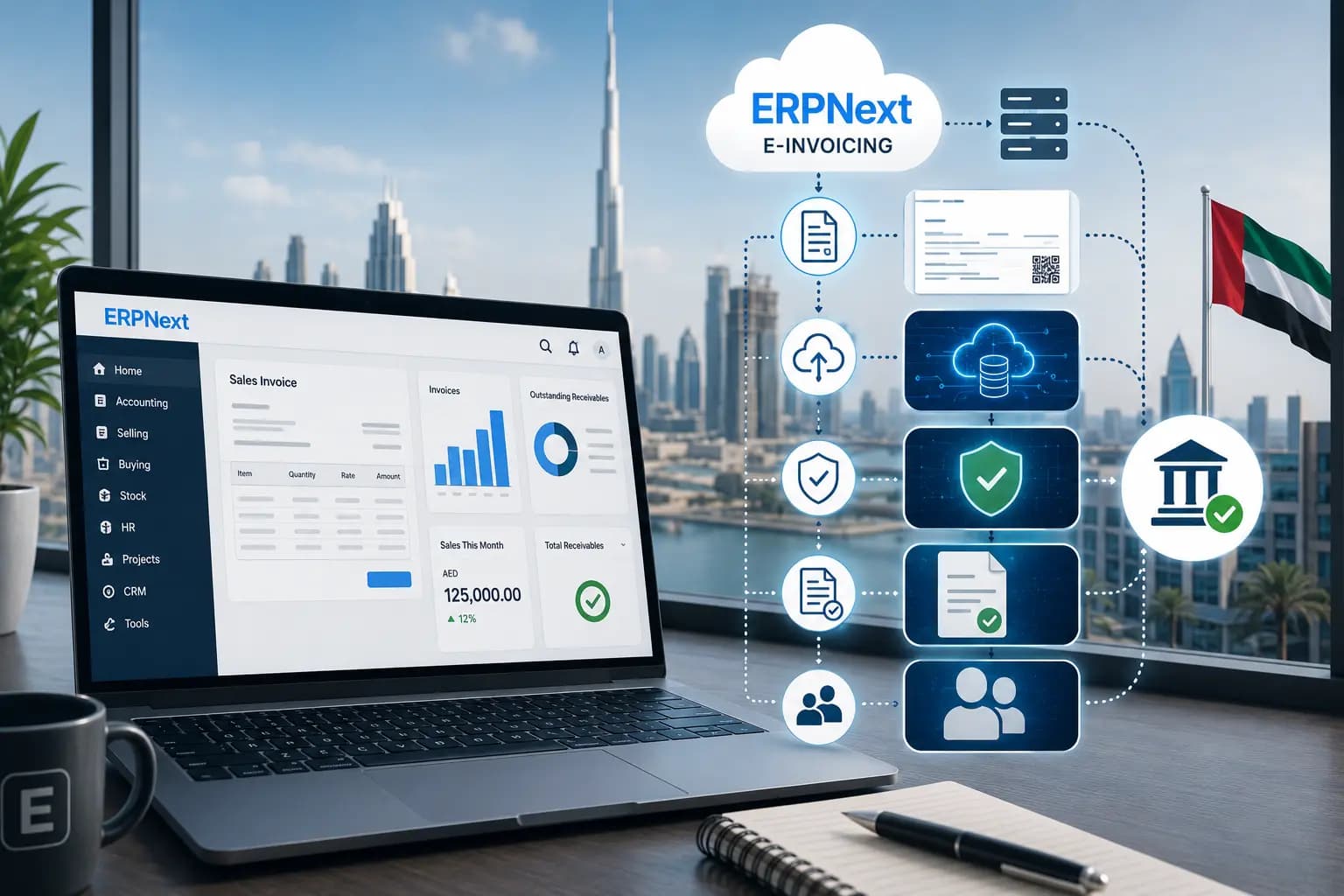
For years, sending an invoice by email felt digital enough. A PDF was created, attached, sent to the customer, and filed somewhere in an inbox or shared folder. The finance team could print it if needed. The customer could approve it. The accountant could use it for VAT records.
That process is still familiar. It is also no longer enough for UAE businesses that fall within the new e-invoicing requirements.
The UAE’s e-invoicing system is not about making invoices look cleaner on a screen. It is about making invoice data structured, readable by systems, traceable, and exchangeable through an approved network. That changes what an invoice needs to be, how it moves, and what an ERP system must do after someone clicks “Submit.”
For businesses using ERPNext, the question is not if the software can create a tax invoice. The real question is if the invoice can be prepared, validated, sent through the correct channel, tracked, and resolved when something goes wrong. And the good news is it can.
UAE E-Invoicing Is Not Just Sending a PDF
A PDF invoice, Word file, Excel sheet, scan, or email attachment may still be useful as a human-readable business document. But on its own, it is not a UAE-compliant electronic invoice under the upcoming framework.
The UAE requires e-invoices to be issued, transmitted, and received in a structured XML format. The standard is based on Peppol PINT-AE, the UAE version of the Peppol International Invoice specification. This means the invoice is not just a document someone reads. It is data that systems can validate automatically. That distinction matters more than people think.
A PDF can show the correct customer name, VAT amount, and total. But it cannot reliably tell another system if the tax category was selected correctly, if the buyer identifier is valid, if an invoice number has already been used, or if a credit note refers to the right original invoice. Structured XML can.
The UAE framework uses a five-corner model:
- Corner 1: Supplier
- Corner 2: Supplier’s Accredited Service Provider
- Corner 3: Buyer’s Accredited Service Provider
- Corner 4: Buyer
- Corner 5: Federal Tax Authority
The supplier does not simply upload invoices directly to the FTA. Instead, the invoice data moves through an Accredited Service Provider, commonly called an ASP. The ASP validates, converts where needed, exchanges the document with the buyer’s ASP, and reports the required tax data to the FTA.


